
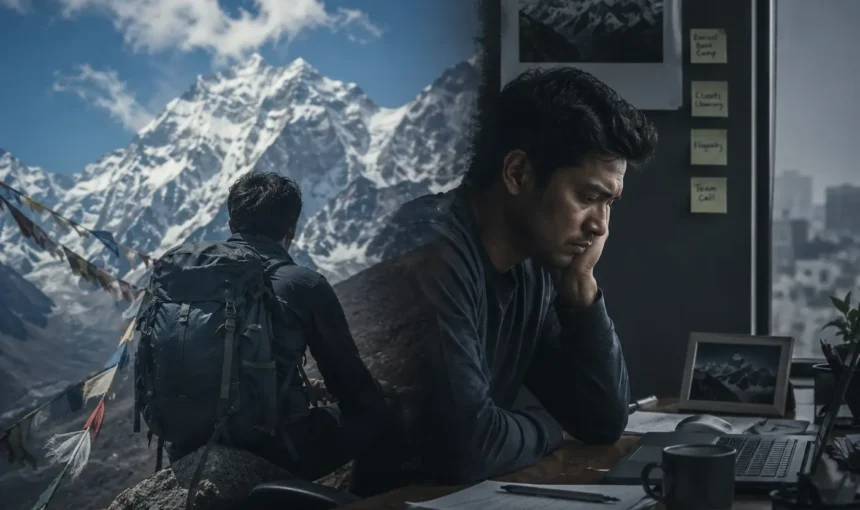
Every season I say goodbye to the same kind of person.
They come to Nepal broken in some quiet way, overworked, overscheduled, carrying something they cannot name. They spend two weeks walking. They eat rice twice a day. They sleep under seven blankets in a room with no heating and wake up at five in the morning because the light on Ama Dablam is doing something that cannot be explained in words, only in presence.
And then they go home.
I hug them at the departure gate. They smell like trail dust and woodsmoke and the particular exhaustion of a body that has been used correctly. They say pheri bhetaula, we will meet again, and their Nepali is terrible and beautiful and I mean it when I say it back.
Three weeks later, the message arrives.
It is always some version of the same message. It comes from London, from Munich, from Amsterdam, from Sydney. It says: I don’t know what is wrong with me. Everything feels grey. I sit in my office and I cannot explain to anyone why I am not okay. The mountains fixed something in me and now ordinary life is breaking it again.
I have read this message so many times I could write it myself.
This is reverse culture shock. It is real, it is common, and almost nobody warns you about it before you board the flight home.
Why Your Body Crashes After Returning Home From a Himalayan Trek
Think about what you were doing for fourteen days.
You woke before sunrise without an alarm because your body understood the light. You walked eight to ten hours, which is not exercise, it is the oldest form of human movement, the thing our bodies were designed for long before chairs existed. You ate simple food at the right times because hunger was honest and immediate. You solved problems that were concrete: this path or that path, this lodge or the next one, enough water, enough warmth, enough rest.
Your nervous system quieted. It had to. The mountains don’t accept the particular noise of modern anxiety, the low-frequency hum of notifications and deadlines and performance reviews. That noise is too small for the Himalaya. The Himalaya simply don’t respond to it, and after a few days, you stop generating it.
You became, briefly, the version of yourself that existed before the modern world built its systems around your attention.
And then you flew home in a pressurised tube, crossed six time zones, and walked back into an open-plan office where someone had sent seventeen reply-all emails about the kitchen rota.
Your nervous system, which had just spent two weeks learning silence, did not know what to do with this.
Neither did you.
Post-Trek Depression Is Real And Nobody Warns You About It
I want to name this carefully because I have watched it happen to hundreds of people and I think we do not take it seriously enough.
It is not just nostalgia. It is not just the post-holiday blues. It is a specific grief, the grief of having been briefly free and then returning to the cage, except the cage is comfortable and air-conditioned and everyone around you thinks you should be grateful.
The hardest part is that you cannot explain it to anyone who was not there.
You try. You show the photographs. The photographs are beautiful, Kala Patthar at sunrise, Gokyo Ri above the clouds, that ridiculous orange tent at base camp against the white of the Khumbu Glacier. People say wow and amazing and you are so lucky and then they ask if you saw anything about the match last night.
The photographs are not the problem. The photographs are the opposite problem, they are too small. They contain the image but not the thing. They do not contain the silence, or the altitude, or the way time moved differently up there, slower and more seriously, as if each hour understood its own weight.
So you stop trying to explain. You sit with it quietly. The grey feeling thickens.
This is the part nobody prepares you for, and it is the part I spend the most time thinking about.
The Airport Goodbye: What “Pheri Bhetaula” Really Means
I said goodbye to a guest at Tribhuvan Airport two seasons ago, a software engineer from Berlin named Marcus, who had come alone, which takes a particular kind of courage. He had never trekked before. He had booked the trip after his company made him redundant and he did not know what else to do with the sudden empty space in his calendar.
He cried twice on the trek. Once on the Kongma La when the pass opened and the whole of the Khumbu glacier lay below him. Once at Tengboche monastery on a quiet afternoon when there was nothing happening at all, just light through the windows and the smell of butter lamps and the sound of monks doing something routine in another room. He could not explain that second one. I told him he did not need to.
At the gate, he shook my hand for a long time.
“Pheri bhetaula,” I said.
He repeated it back slowly. Pheri bhetaula. He had the accent completely wrong. He said it like a question.
Six weeks later he messaged me. He had gone back to work, a new company, a similar job. He sat in a glass building in Berlin and stared at his screen and felt, he said, like he was watching his own life through a window. He was not sad exactly. He just felt that something had shifted its position inside him and had not shifted back.
I told him that was not a problem to be solved. That was information.
How to Keep the Mountain Mindset When You’re Back in a City Office
People use this phrase, mountain mindset, as if it is a wellness product. As if you can bottle it or bullet-point it or practice it in a fifteen-minute morning routine.
You cannot.
But here is what I think it actually is, having watched people find it and lose it for many years:
It is the practice of letting difficulty be simple.
On the trail, difficulty is honest. The pass is steep. Your lungs are working. Your legs are tired. The weather is changing. These are real problems with real solutions: slower pace, deeper breath, better layers, earlier start tomorrow. The difficulty does not pretend to be something else. It does not disguise itself as a meeting or a deadline or a passive-aggressive email. It is just the thing it is.
In the city, difficulty is complicated by narrative. The meeting is not just a meeting; it is evidence of whether you are succeeding or failing. The email is not just an email; it is a signal about your position in the hierarchy. Everything is a problem with ten layers of meaning wrapped around it, and most of those layers are not real.
The mountain strips the layers off. That is why you felt clear up there. That is what you are missing.
You cannot move back to the Himalaya. But you can practice asking, when you are tangled in a complicated problem: what is the actual difficulty here, stripped of the story I am telling about it?
It will not always work. But it will work sometimes, and sometimes is a lot better than never.
5 Things I Tell Every Trekker Before They Fly Home From Nepal
Before every departure day, the last morning, over tea, before the bags go onto the bus, I try to say these things. Not all of them remember. But some do.
Book the next trip before you land. This sounds too simple. It is not. Having a date on the calendar, even a vague one, even two years away, changes the relationship between you and the grey feeling. It becomes a waiting room rather than a permanent address. Marcus booked a Manaslu circuit two months after he got back to Berlin. He said just having the booking made the glass building more bearable. The mountains were no longer something that had happened to him. They were something he was returning to.
Stay in touch with your guide. I mean this genuinely and not as a sales pitch. Your guide knows a version of you that your colleagues do not. They saw you frightened on a pass, and patient at altitude, and generous with porters, and ridiculous trying to cook dal bhat on a camp stove. That is not a small thing. That is a person who knows your real size. Stay in that relationship. It costs nothing. WhatsApp works from everywhere.
Give the photographs six months. Do not look at them immediately. The immediate viewing is too raw; it makes you want to go back before you have had time to integrate where you have already been. Wait until the grey feeling has settled into something quieter. Then look. By then, the photographs will show you something different, not what you have lost, but what you know now that you did not know before.
Walk. This one is almost embarrassingly simple. But the body remembers what the mind forgets. If you can walk for an hour a day, not run, not cycle, walk, the way you walked in Nepal, some of the noise gets quieter. It is not the same. Nothing is the same. But the body is not easily fooled. It knows what movement means.
You Will Find That Person Again: The Promise of Pheri Bhetaula
We say pheri bhetaula, we will meet again, at every goodbye. It is the standard farewell. Guests say it because they have learned it. I say it because I mean it.
But over the years I have come to think it means something larger than the next trek.
The person who stood on Kala Patthar and understood, briefly and completely, that the world is enormous and their problems are small and beauty is real and time is short, that person does not disappear when the plane lands. They go quiet. They get buried under the glass building and the kitchen rota emails and the complicated difficulty with the narrative wrapped around it.
But they are still there.
Pheri bhetaula. You will meet that person again.
Sometimes it takes another trek to find them. Sometimes it takes a long walk. Sometimes it takes sitting very still with a cup of tea and remembering what the silence sounded like at 5,000 metres.
But they are in there. The mountains do not give you something you didn’t already have. They just show you what you brought.
Mount Everest Go runs treks across the Khumbu, Langtang, Manaslu, and Annapurna regions. We believe the mountain does not end at the airport. If you are planning your first trek or your tenth, or if you just need to talk about when the next one might be, find us at mounteverestgo.com or drop me a message directly. I answer everything.
Pheri bhetaula.

 English
 Deutsch
 Svenska
 Dansk
Dansk Русский
 Français
 Português
 Español
 Polski
 简体中文
简体中文 日本語
日本語 ไทย
ไทย العربية
 한국어
한국어