
Honest advice on Nepal trekking etiquette. Find out why you must walk clockwise around Mani walls and Chortens. Avoid common cultural mistakes on the trail.
The Confusion on the Trail Around Stone Structures
You are walking on a narrow path in the Himalayas. The air is thin and your legs are tired. On the side of the trail, you see a long wall made of flat stones. Some have carvings. Some are painted red. There is also a dome-shaped structure nearby. You want to rest. You want to take a photo. You sit on the stone wall because it is flat and stable.
This happens often. Independent trekkers from Europe see these structures as benches or backdrops. They are not. They are religious objects. The confusion starts because there are no signs. There is no fence. There is no guide telling you to stand up. You just see stone. It looks like part of the landscape. But to the people living here, it is sacred. Sitting on it is like sitting on an altar in a church back home. The problem is not malicious. It is just a lack of information before you arrive.
Why Most Travel Blogs Ignore Local Etiquette
You read the forums on Reddit. You check the Facebook groups for trekkers. Most posts talk about gear lists, permit costs, and tea house prices. They talk about the view from the pass. They rarely talk about how to walk past a stone wall. Agencies do not emphasize this either. They worry about selling the trip. They do not want to list rules that might make the adventure feel restricted.
It is also uncomfortable to write about. Telling people they are behaving badly can sound preachy. Many writers skip it to keep the tone positive. They assume you will figure it out when you get there. But by then, you might have already offended someone. The silence on this topic leaves you vulnerable to making mistakes. You think you are being respectful by staying on the trail. But which side of the trail matters here.
The Physical Reality of Trails and Religious Walls
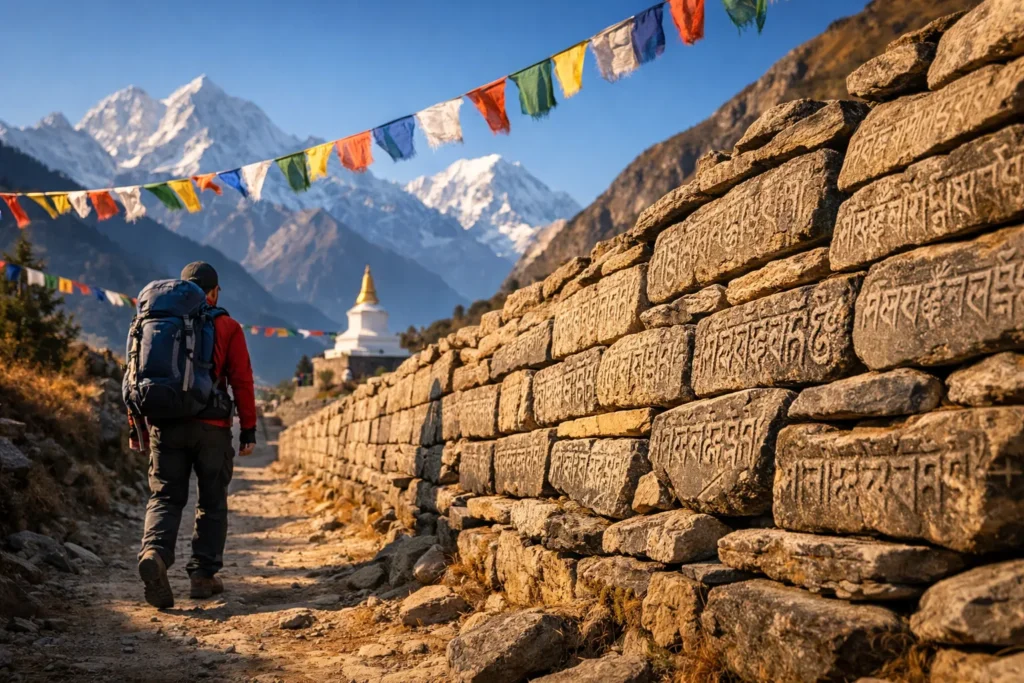
The trails in Nepal are not wide sidewalks. They are dirt paths carved into hillsides. Often, the Mani walls are built directly on the edge of the path. There is no space to walk around them easily. You have to choose a side. In many places, the wall blocks half the path. You must walk between the wall and the cliff edge.
This physical constraint forces a decision. Do you walk between the wall and the mountain, or between the wall and the drop? It seems like a logistical choice. But it is a religious one. The infrastructure is old. It was not built for trekking traffic. It was built for devotion. The narrowness means you cannot ignore the structure. You are forced to interact with it physically every time you pass. This is where the friction happens. You are thinking about your footing. The locals are thinking about your respect.
Distinguishing Between Chortens and Mani Walls
You need to know what you are looking at. A Mani wall is a long barrier made of stones. Each stone usually has a mantra carved into it. A Chorten is a dome-shaped monument, often white with a golden spire. They serve different purposes, but the rule for passing is similar. You should always keep them on your right side. This means you walk clockwise around them.
If you walk counter-clockwise, it is considered bad luck. It goes against the flow of prayer. There are also prayer wheels attached to these structures. When you pass, you should spin them with your right hand. Never your left. Also, check your headwear. Near these sites, remove your hat. It is a sign of respect. These details are small. But missing them marks you immediately as someone who does not understand the culture. It separates you from the environment rather than connecting you to it.
A Local Reaction to Sitting on Sacred Stones
I remember seeing a group from the Netherlands near a village entrance. They were tired. They sat on a low Mani wall to tie their shoelaces. They were taking selfies with the carved stones in the background. An old local man walked past them. He did not shout. He did not stop to lecture them.
He just muttered something under his breath as he walked by. He said, “Pap huncha.” It means “It is a sin.” He kept walking. The trekkers did not hear him. They did not know what he said. But the weight of those words stayed with me. It was not anger. It was disappointment. They were treating a holy object like a park bench. That moment stays with you. You realize your convenience is someone else’s disrespect. It is a quiet shame that you carry for the rest of the trek.

The Serang Gompa Trek is a profound journey into the "Hidden Valley of Kyimolung," one of the sacred Beyuls (hidden…
European Habits Versus Nepali Customs
In Europe, rules are usually written down. There are signs saying “Do Not Sit” or “Keep Off the Grass.” You know where you stand. In Nepal, the rules are implicit. They are understood by the community. They are not written for visitors. This creates a clash for independent trekkers. You are used to finding the information yourself. You expect a sign if something is forbidden.
When there is no sign, you assume it is allowed. This is a dangerous assumption here. The culture relies on observation and intuition. You are expected to watch what the locals do. If they walk around the wall on the left, you do the same. If they take off their hats, you do the same. It requires a shift in mindset. You cannot rely on written instructions. You have to rely on awareness. This feels uncomfortable for people who like clear boundaries.
Common Mistakes That Create Tension
The most common issue is the direction of travel. Walking counter-clockwise is the biggest error. It happens when people are tired and just want to get past the obstacle. They do not think about the spiritual flow. Another problem is touching the carvings. People run their hands over the stones for photos. The oils from your skin damage the old carvings over time.
Boots on the stones are also a problem. Trekking boots are dirty. They have mud and dust from the trail. Putting them on a sacred wall is seen as unclean. These mistakes create tension. The locals do not always say anything. They watch. They talk about it later in the tea houses. Word travels fast in small villages. If you are respectful, you might get a smile or a nod. If you are not, you are just another tourist who does not care.
Who Adapts Quickly and Who Finds It Hard
Some trekkers adjust to this immediately. They are the ones who observe before they act. They watch the porters and the locals. They copy the behavior. These people usually have experience traveling in Asia or other non-Western regions. They understand that their way is not the only way. They are comfortable with ambiguity.
Others struggle. They want the trail to conform to their expectations. They want the rules to make sense to them logically. When the rules are spiritual, they feel irrelevant. These trekkers often feel frustrated. They think the restrictions are unnecessary. This mindset creates stress. It makes the trek feel like a series of obstacles rather than a journey. The physical challenge is hard enough. Adding cultural friction makes it harder.
Final Thoughts on Respect and Awareness
You will pass hundreds of these walls on a long trek. You will pass them without thinking most of the time. But every now and then, you will stop. You will remember the old man muttering. You will check your direction. You will take off your hat. It takes two seconds. It changes nothing about your hike physically. But it changes the atmosphere around you.
It is not about being perfect. It is about noticing. The mountains are big. The culture is old. You are just passing through. Walking to the left of the wall is a small thing. It shows you see the place as more than just a playground. It shows you understand you are a guest. That is enough.


 English
  Deutsch
  Svenska
  Dansk
Dansk  Русский
  Français
  Português
  Español
  Polski
  简体中文
简体中文  日本語
日本語  ไทย
ไทย  العربية