

If you’re planning a trek here, you’ve probably read that you should avoid plastic water bottles. It’s good advice, but the reality on the trail is more complicated. In some places, it’s the law. In others, it’s a messy choice between what’s right and what’s easy. I’ve watched many trekkers from Europe grapple with this, trying to balance their environmental principles with the basic, pressing need for safe water at high altitude. This is how the system actually works, with all its imperfections.
The Gap Between the Rule and the Reality
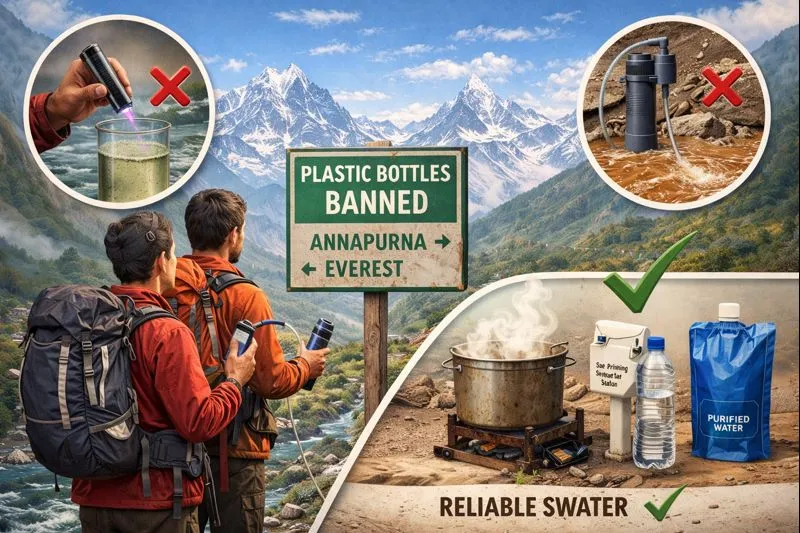
The rule is clear in the Annapurna region. Local authorities have banned glass and plastic bottles from being taken to areas like Annapurna Base Camp and Mardi Himal. They ask tourists to carry out all their waste. In villages like Chhomrong, lodge committees have successfully banned plastic water bottles. The Everest region has also banned single-use plastics, but with a critical exception: plastic water bottles are still allowed. The local government there is still consulting on what to do about them.
This creates two different realities. On the Annapurna Circuit, you physically cannot buy a plastic bottle of water in many places. Your choice is made for you. On the trail to Everest Base Camp, you will see them for sale. Every day, you have to choose: buy the convenient bottle and contribute to a known waste problem, or commit to a more cumbersome purification method. It’s a personal ethical test that plays out repeatedly.
Why the Simple Solutions Often Fall Short
Online guides list the standard options: boiling, filters, chemical tablets, UV pens. What they often gloss over are the specific frustrations each one brings in the Himalayan context.
Boiling water is reliable but impractical. You need to boil it for three minutes above 2,000 meters. In teahouses, you pay for each cup or thermos. For the 3-4 liters you need daily to stay hydrated at altitude, this adds up. You’re also forever waiting for it to cool down when you’re thirsty.
UV purifiers like SteriPens are popular, but their batteries fail in freezing cold unless you sleep with them in your sleeping bag. Iodine or chlorine tablets work but leave a chemical taste many find unbearable. The most common alternative, chlorine dioxide tablets or drops, are better. They are effective against tough parasites like Giardia and don’t leave a strong aftertaste. But you still must wait 30 minutes, or up to two hours in cold water, for them to work.
How Water Actually Works in the Teahouses
Forget a single, standardized system. Water management varies from lodge to lodge.
The Two-Bucket System and Filter Doubt
A common setup is the “two-bucket system”: one bucket with a tap for untreated pani (water), and another with filtered or boiled water you pay for. Sometimes the filtered water comes from a large electric purifier.
Your job is to observe. Before you fill your bottle from a filtered system, ask the lodge owner when the filter was last changed. A polite, “Filter kahile change garnubhayo?” goes a long way. The answer is often vague. I’ve seen filters that look older than the trekking boots hanging by the door. This doesn’t mean the water is bad, but it introduces doubt. This doubt is what pushes tired, thirsty trekkers toward the seeming certainty of a sealed plastic bottle.
A Moment of Uncomfortable Clarity
One afternoon in a busy lodge, I saw a young porter, what many would call the “lodge boy,” take an empty branded “Mineral Water” bottle to the outdoor tap. He filled it from the pani bucket, screwed the cap on tightly, and placed it on the counter for sale. It wasn’t malicious. It was logistical. Demand was high, the filtered water dispenser was empty, and this was the fastest way to restock.
It was a clear, quiet illustration of the entire cycle. A trekker buys that bottle, drinks it, and discards it, believing they’ve consumed something pure and safe. The bottle becomes trash that can’t be processed locally. It might be burned, releasing toxic fumes, or it will remain in the mountains. The demand created the shortcut.
When European Sensibilities Meet the Trail
For trekkers from Germany, the Netherlands, or Scandinavia, this is particularly challenging. There’s a deep-seated expectation of systematic order and transparent eco-practices. You expect a filter to have a maintenance log, a rule to be uniformly enforced, and “filtered water” to mean what it says.
Here, you must adjust that mindset. The ecological intention in places like Annapurna is very real and community-led. But the execution is human, under-resourced, and adapted to local realities. Your control is limited to your own choices. The system isn’t designed for your scrutiny; it’s designed to function. Getting frustrated at the lack of perfection is a sure way to ruin your day.
Featured Trip


What Generally Works and What Causes Headaches
Through trial and error, a pattern emerges. The trekkers who seem most at peace with this issue follow a hybrid, flexible approach.
They carry two reusable bottles: one for treated water, one for tea. They use chlorine dioxide drops as their primary method because they’re light, work in cold water, and don’t taste bad. They pay for boiled water at dinner to fill a bottle for their sleeping bag, a heater and next day’s water. They use the occasional “safe water” station on the Annapurna circuit when available. And, sometimes, on a brutally cold, exhausting day, they might buy a single plastic bottle of soda for a morale boost, then carry the empty out. They don’t seek purity; they seek a manageable balance.
Struggle comes from rigidity. The trekker who insists only on their UV pen, then faces dead batteries. The one who refuses any chemical taste and spends a small fortune on boiling water. The one who buys bottles daily but is then weighed down by guilt.
Who Manages This Best, and Who Finds It a Burden
This situation suits pragmatic people. Those who see it as a logistical puzzle to solve, not a moral failing of the country. It helps to be a bit of a gear nerd, interested in the how of water purification. A stubborn commitment to “leave no trace,” even when it’s inconvenient, is the best motivator.
It’s harder for those who need absolute certainty about what they’re drinking, or who have sensitive stomachs that react to the slightest change. The constant minor calculations, waiting times, drop counts, and cost comparisons can drain mental energy you’d rather spend on the views.
The Real Choice You Make
In the end, the ban on plastic bottles isn’t really about Nepal. It’s about you. The mountains will be here long after this season’s empty bottles are buried or burned. The regulations are an attempt to protect them. But every day, the trail presents you with a simple option: convenience for you, or a longer life for this landscape.
Choosing to purify your own water is a small, continuous act of respect. It’s slower. It sometimes tastes a little off. It requires forethought. But it means that when you look out from Thorong La or gaze at Everest, you know your thirst didn’t leave a permanent mark. You just passed through, and that’s all.

 English
  Deutsch
  Svenska
  Dansk
Dansk  Русский
  Français
  Português
  Español
  Polski
  简体中文
简体中文  日本語
日本語  ไทย
ไทย  العربية