
Stop calling every Nepali porter a “Sherpa.” Discover the true meaning of this ethnic identity and why making this common trekking mistake makes you look ignorant.
The First Time You Realise You Have Been Saying It Wrong
You land in Kathmandu, having watched every Everest documentary on Netflix. You know the names Tenzing Norgay and Ed Viesturs. You feel prepared. Then, on the bus to Pokhara, you point at a young man strapping a duffel bag to his back and say, “Look, there goes a Sherpa.” The Nepali sitting next to you pauses. Then, quietly: “He is not a Sherpa. He is Magar.”
That small correction is the start of something that bothers you for the rest of the trek. Not because anyone is angry. But because you realise, slowly, that one of the first things you thought you understood about Nepal was wrong.[1]
Why Travel Blogs Keep Getting This Wrong
The confusion is not new. When Edmund Hillary and Tenzing Norgay reached the summit of Everest in 1953, Western media latched onto the word “Sherpa” and turned it into shorthand for any high-altitude worker. Seventy years of documentary narration, magazine features, and Google results have reinforced that mistake.
Most trekking blogs and agency websites do not bother to correct it. It is simpler to write “our Sherpas will carry your bags” than to explain that the porter crew includes Gurung, Magar, Rai, Tamang, Brahmin, Chhetri, and possibly one or two actual Sherpas who came from Solukhumbu for the work. The nuance does not sell packages. So it gets flattened, and first-time trekkers arrive already misinformed.
What the Word Sherpa Actually Means
Sherpa (shar pa) literally means “people from the east” in Tibetan. It is a Tibeto-Burman ethnic group that migrated from eastern Tibet several centuries ago and settled in the Solukhumbu district of northeastern Nepal, the region surrounding Everest. Sherpas have their own language, clans, and Buddhist traditions distinct from other Nepali groups.[2]
According to Nepal’s 2021 census, Sherpas make up roughly 0.45 percent of the national population, about 112,000 people.[3] Nepal has 142 recognised ethnic groups. Magar (about 7 percent), Tharu (around 6 percent), Tamang (about 5.6 percent), and Gurung (nearly 2 percent) are all significantly larger. On the Annapurna trails specifically, you are far more likely to walk alongside Gurung, Magar, and Rai porters than Sherpas, who are geographically concentrated in the Everest region.
Calling every porter or guide a “Sherpa” is not just inaccurate. It is the equivalent of calling every white person in Europe a “CEO” or assuming everyone in Scotland is a Highlander because you watched Braveheart. The word has a real, specific meaning.
Who Actually Carries the Bags on Nepal’s Trails
If you trek the Annapurna Circuit or Annapurna Base Camp, the person carrying your gear is most likely not Sherpa. He is probably Gurung, from the hills around Pokhara. Or Magar, one of Nepal’s largest indigenous groups, spread across the mid-hills. Or Rai, whose communities lie in the eastern hills. These are the people who do the overwhelming majority of porter work on Nepal’s most popular non-Everest trails.[4]
On Everest Base Camp treks, the situation shifts. There, Sherpas are more common because you are walking through their homeland. But even there, many load-carriers at lower altitudes are Tamang or Rai. Not all Sherpas work in the mountains, and not all mountain workers are Sherpas.
Ethnicity matters here. A Gurung porter from Lamjung has a different language, different customs, and a different family history than a Sherpa guide from Namche Bazaar. Grouping them under one label erases those differences.[5]
Trips to the Everest region


The Quiet Conversation at the Tea House
I saw it happen in a tea house below Machapuchare Base Camp. A European trekker, genuinely trying to be kind, pointed at a young porter who had just arrived carrying two large sacks and a cardboard box tied with rope. The trekker turned to his friends and said, loudly enough for everyone to hear, “That is what I call a real Sherpa. Look at that load.”
The porter, setting his load down, did not look up. But the Nepali guide standing nearby winced. He leaned toward me and muttered, in Nepali: “Uha Sherpa hoina” (he is not Sherpa). He did not correct the tourist. That is not how things work here. So the moment passed, and the European walked away feeling good about his compliment, and the porter sat on a bench and drank water.
What Everest Documentaries Leave Out about Sherpa
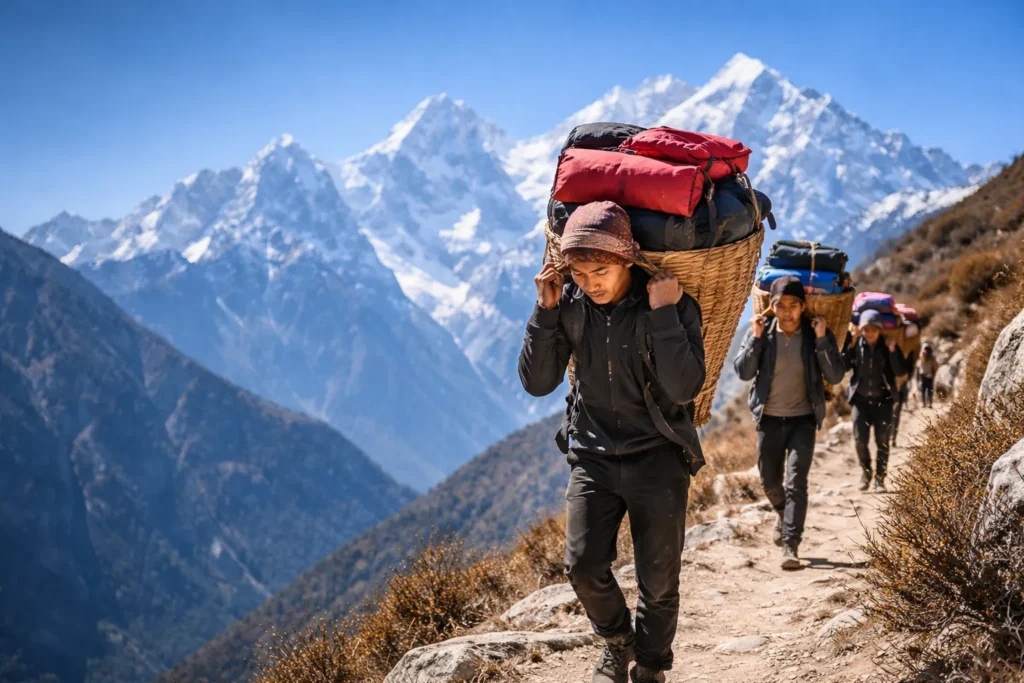
Most Europeans arrive in Nepal with a mental image built from documentaries. They have seen Sherpas fixing ropes on the Lhotse Face, summiting in borrowed boots, mourning their dead. These portrayals are real, but they are narrow. They show one ethnic group in one region doing one type of work. What those films do not show is the mid-hill farmer who takes three weeks off to carry bags for tourists, or the young Rai woman walking six hours a day on steep stone steps with thirty kilos on her back. The gap between the documentaries and the actual trails is where the ignorance lives.
What Most Trekkers Adjust To and What Stays Awkward
After a few days on the trail, most trekkers start to notice the ethnic diversity around them. The guide’s surname might be Gurung, the lodge owner is Thakali, the young man making dal bhat is Newar. Some trekkers ask their guides. Some overhear porters talking and notice they are speaking different languages. The simplest adjustment is to stop using “Sherpa” as a job description and just say “porter” or “guide.” If someone tells you their ethnicity, use that.
Who Handles This Well and Who Finds It Difficult
Trekkers who have been to Nepal before tend to handle this better, because they have already been corrected by a guide or another traveller. First-timers, especially those who come straight from an Everest media binge, are more likely to carry the misconception. Age does not guarantee sensitivity. I have seen trekkers in their fifties who still use “Sherpa” as a universal term for anyone in a down jacket, and twenty-two-year-olds on their first trip abroad who ask the right questions by the first afternoon. It comes down to curiosity more than anything else.
Something Worth Carrying Home
Nepal is a country of extraordinary ethnic diversity, and the mountains are only one part of it. The trails are walked by people from dozens of communities, each with their own history, language, and relationship to the land. Reducing all of that to a single word, a word that was never meant to describe a job in the first place, does a disservice to everyone involved.
You do not need to become an expert in Nepali ethnography to trek here. But you do need to understand that the person carrying your bag has a name, a family, and an ethnic identity that may not be what you assume it is. That is not political correctness. It is basic respect. And it makes the experience of walking through those mountains considerably more honest.
References
[1] ABC News Australia, ‘Inside the world of Nepal’s misunderstood Sherpas,’ March 2023.
[2] Wikipedia, ‘Ethnic groups in Nepal,’ citing Nepal National Population and Housing Census 2021.
[3] Himalayan Masters, ‘Everest Porters: The Hidden Heroes Behind Each Summit.’
[4] Wikipedia, ‘Sherpa people.’
[5] Far East Travels, ‘Not All Mountain Guides And Porters Are Sherpa.’
[1]ABC News Australia, ‘Inside the world of Nepal’s misunderstood Sherpas,’ March 2023. https://www.abc.net.au/news/2023-03-05/nepal-sherpa-community-culture-alive-tourism-everest-himalaya/102008554
[2]Wikipedia, ‘Sherpa people.’ https://en.wikipedia.org/wiki/Sherpa_people
[3]Wikipedia, ‘Ethnic groups in Nepal,’ citing Nepal National Population and Housing Census 2021. https://en.wikipedia.org/wiki/Ethnic_groups_in_Nepal
[4]Himalayan Masters, ‘Everest Porters: The Hidden Heroes Behind Each Summit.’ https://himalayan-masters.com/everest-porters
[5]Far East Travels, ‘Not All Mountain Guides And Porters Are Sherpa.’ https://fareasttravels.com/travel-ideas/not-all-mountain-guides-and-porters-are-sherpa


 English
  Deutsch
  Svenska
  Dansk
Dansk  Русский
  Français
  Português
  Español
  Polski
  简体中文
简体中文  日本語
日本語  ไทย
ไทย  العربية