

You’ve just landed in Kathmandu. Your bag is packed, your boots are beside you, and you’re looking at a map. You’re fit. You’ve done your long walks in the Alps or the Scottish Highlands. Your mind is set on reaching those high passes. And everyone, from the guidebook to the man at the gear shop, tells you the same thing: “Walk slow.” In Nepali, they say it twice for emphasis: “Bistarai, bistarai.” You nod. You think you understand. But you don’t, not yet. Because for you, “slow” is a tactic. For the mountains here, it is the entire strategy.
The Advice You Hear But Never Really Accept
The problem isn’t the advice. The problem is you. I mean the general “you.” The trekker from London, Berlin, or Paris who is used to efficiency. You see a trail, you see a goal, and your body is a machine to cover the distance. You accept “walk slow” the way you accept “drive safely”, as a sensible suggestion, not a physical law. On the first day, with the sun out and adrenaline high, a slow pace feels ridiculous. You’ll overtake porters, you’ll reach the tea house by lunch, and you’ll feel fantastic. This is where the misunderstanding takes root. You believe your fitness is protecting you. It is not.
Why the Simplest Truth about Altitude Sickness Gets Buried
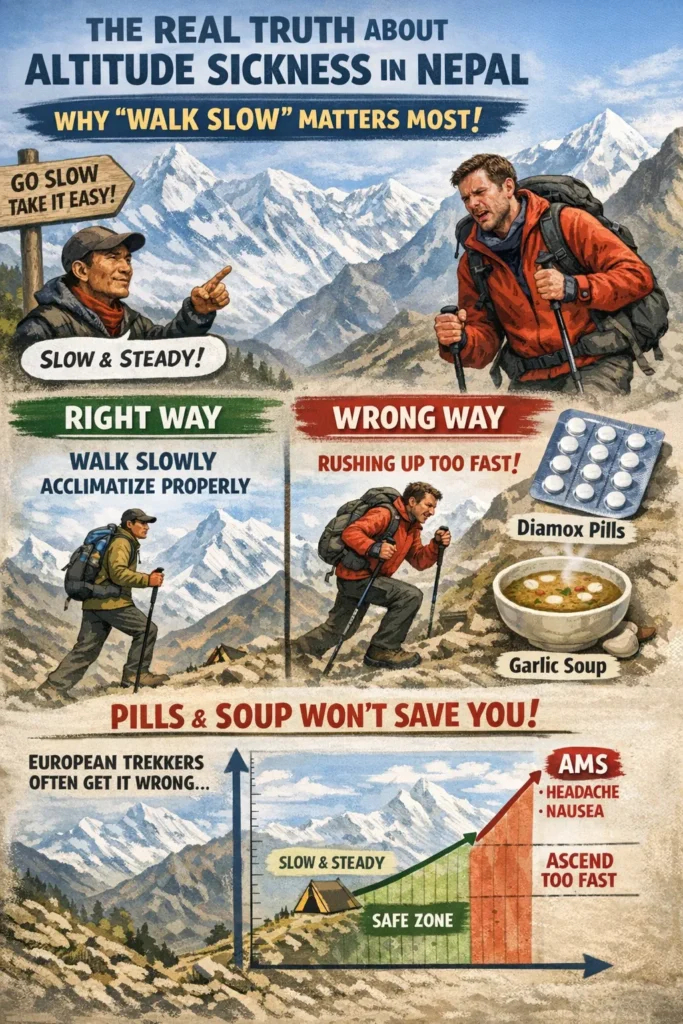
Agencies and many online resources have a conflict. They need you to feel prepared, but they also need the trek to seem achievable. So they offer a compromise: a pill. Acetazolamide, known as Diamox, is presented as a preventative shield. It’s discussed on forums like a required piece of gear. This creates a dangerous illusion of control. It suggests you can manage a physiological process with pharmacology. The older, slower, and less sellable truth, that you must let your body dictate the schedule, gets sidelined. It’s not glamorous. It doesn’t fit a packing list.
How Altitude Decisions Are Really Made on the Trail
On the ground, things are messy. A guide might work for a company that pushes tight itineraries to fit client holidays. He knows the schedule is aggressive. He also knows his income depends on you finishing. So he walks a line. He will say “bistarai,” but he may not insist you stop for an extra acclimatization day unless you show clear signs of sickness. The decision often comes down to you. The tea house owner will serve you garlic soup, a folk remedy believed to help, and nod encouragingly. There is no strict protocol, only a series of individual judgements, often made by people already feeling the pressure of time and money.
Noticing the Signs Your Body Gives You
The first real sign for many is at night. You lie down, and your breathing changes. You drift off, then your brain jolts you awake because you’ve stopped breathing for a few seconds. This is Cheyne-Stokes or periodic breathing. It’s common, but it’s your body saying it’s stressed. Another sign is a relentless, dull headache that painkillers only touch briefly. The dangerous mindset here is to treat these as separate inconveniences, a bad sleep, a headache, to be medicated through. Diamox can mask the headache. It can even help with breathing. But if you are ascending too fast, the drug is just silencing the alarm while the fire spreads. The collapse, when it comes, can be sudden.
A Moment of Unspoken Concern
You’re sitting on a lodge bench, feeling rough. Your guide, Gopal, takes your wrist. He counts your pulse, looking at his watch. He says, “Ramro nai dekheko chha.” It seems you are doing okay. But he holds your wrist a moment too long. He doesn’t look at your eyes; he looks at the space between them. He’s not just checking your pulse. He’s assessing your capillary refill, your skin colour, your focus. The words are polite, reassuring. The silence around them is the real diagnosis. He’s weighing whether he needs to have a difficult conversation about turning back.
When a Trek Feels Like a Race You Can’t Win
This is where the European mindset, particularly the goal-oriented one, struggles. You are used to pushing through. You see the trail as a linear challenge. The mountain, however, is a spherical negotiation. It’s not about speed; it’s about adaptation. The most common point of failure I’ve seen is the person who treats each day’s climb like a personal best attempt. They resist the monotonous, plodding pace. They feel shame at being passed by older hikers or local porters. They fight the sensation of weakness. That fight is what exhausts the body’s reserves and makes altitude sickness more likely.
Patterns of Adaptation and Resistance
The people who move through the landscape with the least distress are the ones who surrender to its pace. They are not necessarily the fittest. They are the ones who stop when tired, not when the map says to. They drink water constantly, not in large gulps. They understand that a rest day isn’t a day off; it’s the main work of the trek. The people who create problems are often those who, feeling fine, decide to “make up time” or skip a planned acclimatization day. Another problem is the belief that a drink in the evening will help you relax. Alcohol is a respiratory depressant at a time when your body is desperate for oxygen. It’s a terrible trade.
Who Manages This Well, and Who Finds It a Battle
This situation fits people who are comfortable with uncertainty. Who can separate ego from achievement. If your satisfaction comes from checking off a destination, the process will frustrate you. If your satisfaction can come from the process itself, the slow change in light, the rhythm of walking, the simple fact of being there, you’ll fare better. Physically, it’s notoriously unpredictable. Young, fit athletes can be hit hard. Older, methodical walkers often cruise through. The common factor in those who struggle is a reluctance to listen, truly listen, to the body’s whispers before it starts screaming.
Letting Go of the Timeline
In the end, the mountain doesn’t care about your flight home. The garlic soup is a comforting tradition, not a cure. The Diamox is a tool, not a guarantee. The phrase “bistarai, bistarai” isn’t about walking. It’s about existing. It’s the understanding that some processes cannot be hurried. The silence at altitude isn’t just an absence of sound; it’s a demand for a different kind of attention. You learn that the hard way, or you learn it in a helicopter on the way down. There is no shame in either, but only one lets you keep walking.


 English
  Deutsch
  Svenska
  Dansk
Dansk  Русский
  Français
  Português
  Español
  Polski
  简体中文
简体中文  日本語
日本語  ไทย
ไทย  العربية